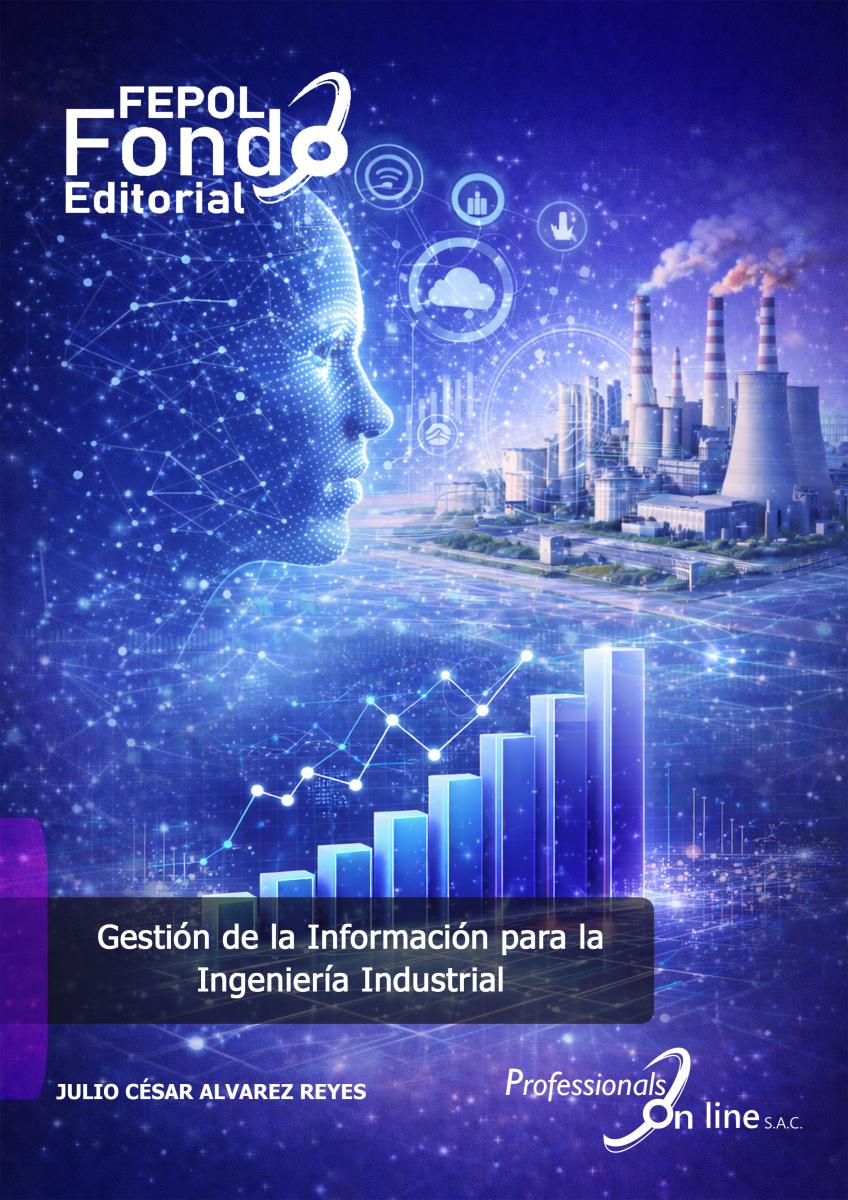
Gestión de la Información para la Ingeniería Industrial
Keywords:
Gestión de la Información , Ingeniería IndustrialSynopsis
En la actualidad, las organizaciones industriales operan en entornos caracterizados por una alta complejidad, dinamismo y presión competitiva. La automatización de procesos, la digitalización de operaciones y la interconexión de sistemas han multiplicado la cantidad de datos disponibles, generando nuevas oportunidades, pero también nuevos desafíos para la gestión empresarial.
En este contexto, la información se consolida como un activo estratégico fundamental. No se trata únicamente de disponer de grandes volúmenes de datos, sino de contar con la capacidad organizacional para transformarlos en información confiable y, posteriormente, en conocimiento útil para la toma de decisiones. La Ingeniería Industrial, por su naturaleza integradora, ocupa un rol central en este proceso.
Downloads
Download data is not yet available.
References
Alvarez, J. (2026). Bases de datos para la Ingeniería Industrial (1.ª ed.). Fondo Editorial.
Chaffey, D., y White, G. (2019). Business information management: Improving performance using information systems (3.ª ed.). Pearson.
Davenport, T. H., y Harris, J. G. (2017). Competing on analytics: The new science of winning (2.ª ed.). Harvard Business Review Press.
Han, J., Kamber, M., y Pei, J. (2011). Data mining: Concepts and techniques (3.ª ed.). Morgan Kaufmann.
James, G., Witten, D., Hastie, T., y Tibshirani, R. (2021). An introduction to statistical learning: With applications in R (2.ª ed.). Springer. https://doi.org/10.1007/978-1-0716-1418-1
Kimball, R., y Ross, M. (2013). The data warehouse toolkit: The definitive guide to dimensional modeling (3.ª ed.). Wiley.
Kleppmann, M. (2017). Designing data-intensive applications: The big ideas behind reliable, scalable, and maintainable systems. O'Reilly Media.
Laudon, K. C., y Laudon, J. P. (2021). Management information systems: Managing the digital firm (17.ª ed.). Pearson.
Lorraine, C. (2020). Decision intelligence: A toolkit for managers. CRC Press.
Montgomery, D. C., y Runger, G. C. (2018). Applied statistics and probability for engineers (7.ª ed.). Wiley.
O'Neil, C. (2016). Weapons of math destruction: How big data increases inequality and threatens democracy. Crown.
Provost, F., y Fawcett, T. (2013). Data science for business: What you need to know about data mining and data-analytic thinking. O'Reilly Media.
Reis, J., y Housley, M. (2022). Fundamentals of data engineering: Plan and build robust data systems. O'Reilly Media.
Shmueli, G., Patel, N. R., y Bruce, P. C. (2017). Data mining for business analytics: Concepts, techniques, and applications in R. Wiley.
Goodfellow, I., Bengio, Y., y Courville, A. (2016). Deep learning. MIT Press.
Géron, A. (2022). Hands-on machine learning with Scikit-Learn, Keras, and TensorFlow (3.ª ed.). O'Reilly Media.
Molnar, C. (2022). Interpretable machine learning: A guide for making black box models explainable. Leanpub.
Russell, S., y Norvig, P. (2020). Artificial intelligence: A modern approach (4.ª ed.). Pearson.
Sutton, R. S., y Barto, A. G. (2018). Reinforcement learning: An introduction (2.ª ed.). MIT Press.
Downloads
Published
March 9, 2026
Series
Online ISSN
2955-8549
Categories
Copyright (c) 2026 Julio César Alvarez Reyes
License

This work is licensed under a Creative Commons Attribution-NonCommercial 4.0 International License.
Details about this monograph
ISBN-13 (15)
978-612-99409-0-8
How to Cite
(Ed.). (2026). Gestión de la Información para la Ingeniería Industrial: Vol. Primera edición. Fondo Editorial FEPOL. https://doi.org/10.47422/nn3f4589